
A LAYMAN LOOKS AT RUST FOR THE FIRST TIME
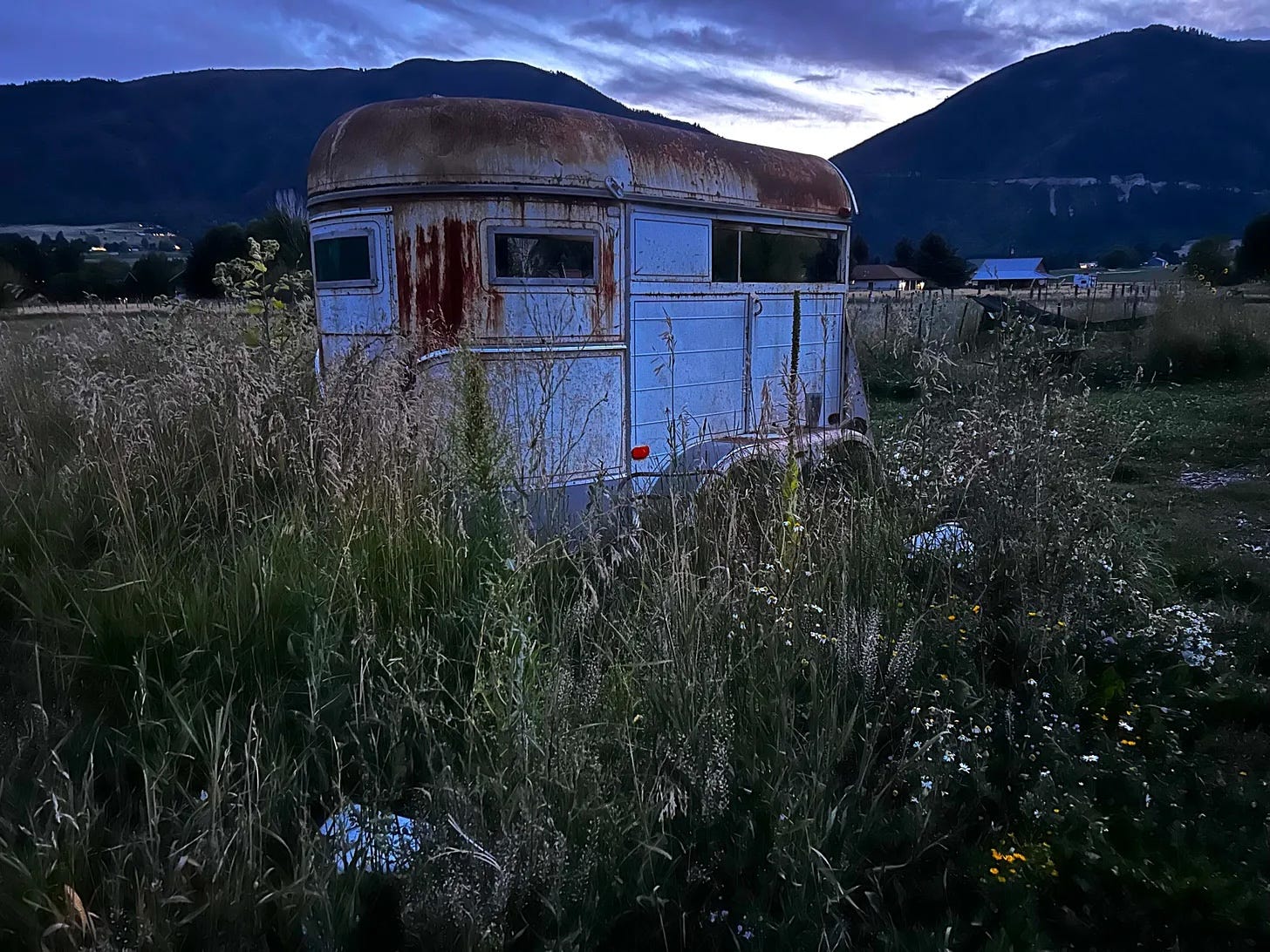
Rust is formed when ferrous metals —
those with iron in their composition —
interact with oxygen and water and, of course, time.
Chemists understand
4Fe (iron) + 3O₂ (oxygen) + 6H₂O (water) → 4Fe(OH)₃ (rust)
Molecular simplicity.
The iambs and trochees and anapests
of science’s native tongue.
Iron in the metal surface first loses electrons,
becomes iron(II) ions (Fe²⁺).
Oxygen from the air picks up these electrons
in the presence of water or hydrogen ions,
becoming hydroxide ions (OH⁻).
The iron(II) ions react with these hydroxide ions
to form iron(II) hydroxide.
Further oxidation by oxygen and reaction with water
then forms hydrated iron(III) oxide (Fe₂O₃•H₂O),
which is what we recognize as rust.
But the layman only gets part of the story.
The ending, really.
What we know:
Our cars or patio chairs or tools or
fish hooks or firearms or grills or cast iron skillets
or old gas station signs or horse trailers or bicycles
or children’s toys or bodies —
over the course of days, weeks, months, years —
through nothing more than existing, begin to gather
a slow intertia of reds and oranges and browns.
The creep of shape, of form and function, changing
into a weaker, compromised, unattractive version
of what used to be.
Small town crouched a mile from the bypass.
Horizon-strewn relics of a family farm.
Conversations and relationships long silent and distant.
Best intentions left unfinished
in the deepening grass and fading color of wildflowers
or on a musty garage or barn floor.
Passions un-sunlit in favor of lesser distractions.
Lungs that struggle to fill, hearts straining to beat,
imagination that knows nothing beyond
what we can hold in the palm of our hands,
patience eclipsed by ready anger.
Rust is not the means to an end,
but a call, a slow emergency
broadcast, a reminder —
sent from the invisible world
beyond our comfort and fractured inattention —
that there is still time to make good
on our discourse and the poetry of life
despite what we’ve already taken for granted.
Written in response to the latest community writing prompt — an ekphrastic poem inspired by the image above.